



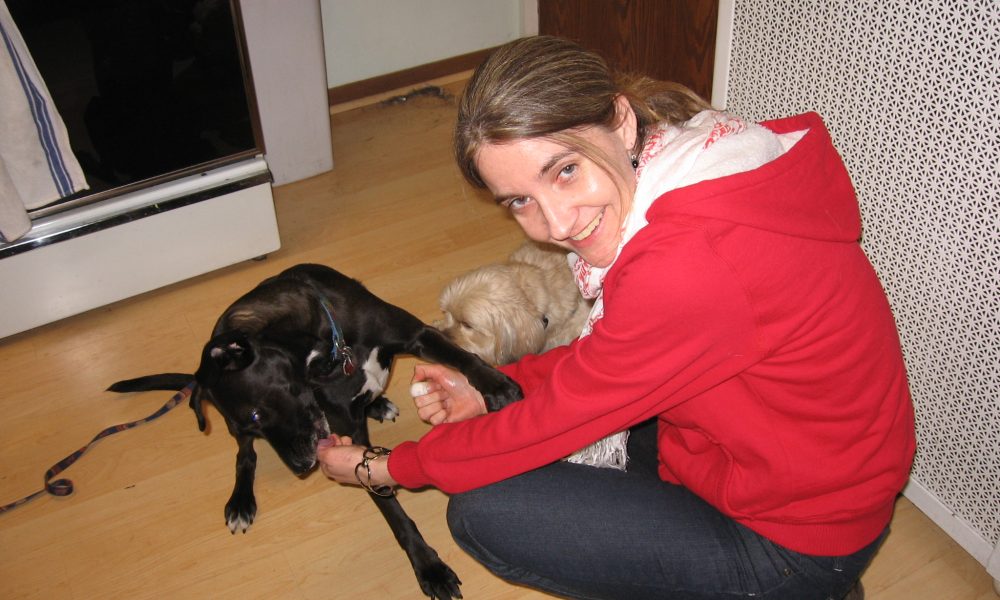
Today we’d like to introduce you to Valerie Chalcraft.
Valerie, please share your story with us. How did you get to where you are today?
While in college at the University of California, Berkeley, I became interested in the abnormal behavior of animals that results from captivity. After college, I worked for a group of psychologists who studied animal welfare and the ways humans use animals. I realized that if I were to advocate for animals, I needed to learn about how a variety of species perceive and interact with their environments. So I enrolled in the Experimental Psychology program at the University of Nevada, Reno. Psychologists like myself seek to apply unifying principles of learning across species (including humans).
My graduate school advisor was the behaviorist, R. Allen Gardner — a behaviorist is a type of psychologist who looks only at environmental contingencies and external behavior without invoking mental explanations. While I have interest in cognition, my training has conditioned me to closely examine evidence and assumptions. While I designed a PhD exam for myself in the welfare of animals in captivity (in particular, primates in laboratories), the topics of my MA thesis and PhD dissertation focused on how chimpanzees learned to use the signs of American Sign Language (ASL).
In addition to psychologists, there are researchers and practitioner of animal behavior from a number of fields, including ethology, biology, and zoology. All of these fields overlap. One principle I took from my years in graduate school is from the first ethologist, Charles Darwin, who indicated that, differences between species are of degree and not kind.
Applied Animal Behavior is just myself, applying the principles of animal behavior primarily to home and shelter settings. I have also consulted on the behavior of animals in laboratories. I use similar approaches across species with some modifications depending on species-specific or individual behavior. I developed the feline behavior program and consulted on canine behavior for the Evanston Animal Shelter. I have also consulted on canine behavior for Heartland Animal Shelter in Northbrook and PAWS Chicago. The behaviors I address include fear, a wide range of aggression types, house soiling, compulsive behaviors and destructive behavior.
Finally, I teach several online feline behavior courses as there has been an uptick in interest in feline behavior – thanks to a popular TV show “My Cat From Hell” based on the type of in-home consulting I do. Thankfully, I agree with most of the approaches taken on that show!
Has it been a smooth road?
I have no business background and am too busy with the work to learn if I could be a better business owner. I know I could market myself more.
I tell guardians that behavior cases are like a puzzle with a number of pieces. Often they have one or two pieces already before contacting me and are frustrated that these pieces alone don’t fix it. Showing guardians how all the pieces interact to problem solve can be a challenge. Also, guardians often hope I will fix the problem during the visit. Requesting patience and encouraging small victories to build more solid foundations are challenges too.
So let’s switch gears a bit and go into the Applied Animal Behavior story. Tell us more about the business.
While in the past, I took on mostly dog cases and a few cat cases, these days I take on mostly cat cases and a few dog cases. I am the only psychologist in Chicago who takes on animal behavior cases and I work in conjunction with many veterinarians in Chicago and suburbs. I have been known to travel a couple of hours to take on a behavior case.
With both dogs and cats, Fear manifests on its own and can also underlie aggression. Both species may show territorial aggression to other animals and to humans, both species may challenge their guardians, and seek attention through nuisance or destructive behavior. Both species indicate stress and mark territory with urine and feces, and both may housesoil due to improper house training or less-than-optimal opportunities for elimination. Stress may also manifest in repetitive, compulsive behavior and that may be self-injurious.
I take on a variety of cases that usually fall into the above categories. I work to identify triggers, maintain warnings, gradually expose the cat or dog to challenges in a controlled way and paired with high-value rewards. I teach alternative behaviors that replace the undesirable behavior. Finally, I consult on how to reduce overall stress and energy levels so the cat or dog is calmer and more open to learning new behavior.
How do you think the industry will change over the next decade?
With cats taking over as the most popular companion animal, and the continued presence of cat behavior on popular television (“My Cat From Hell”), I expect interest to continue to expand.
Education is always needed to prevent as well as to solve problems. There are still a lot of people who generalize the belief that cats are “independent and aloof” when in fact, cats are just as varied in personality as humans as we are all products of how our genes and environment combine.
I hope to see more “applied” animal behavior courses in colleges and universities. Right now, if you want to study and address the behavior of a cat or dog in a human home, there are only online certificate programs available.
Pricing:
- I generally offer in-home packages (visit, reports, and follow-up) for $300.
Contact Info:
- Website: http://www.appliedanimalbehavior.com
- Phone: (312) 391-5537
- Email: info@appliedanimalbehavior.com
- Facebook: https://www.facebook.com/Applied-Animal-Behavior-182790755095681/


 Image Credit:
Lynn Trautmann
Getting in touch: VoyageChicago is built on recommendations from the community; it’s how we uncover hidden gems, so if you know someone who deserves recognition please let us know here.


John Laskey
December 24, 2018 at 3:00 pm
I have two ferels living in my home ( they were only a few months old when I found them near the woods) for the past 8 years. Recently I took in a stray that I had been feeding for two years. Integrating cats to live together peacefully is no easy task. Dr. Chalcraft consulted with me for two hours and then came to my home for two hours to work with the cats . She was great in her approach and in her knowledge. I think that I can make this work following Dr. Chalcrat’s advice. She is very hands on when in your home. I learned to use play and food as a calming device. I would strongly recommend consulting with her for your animal behavior problems.