



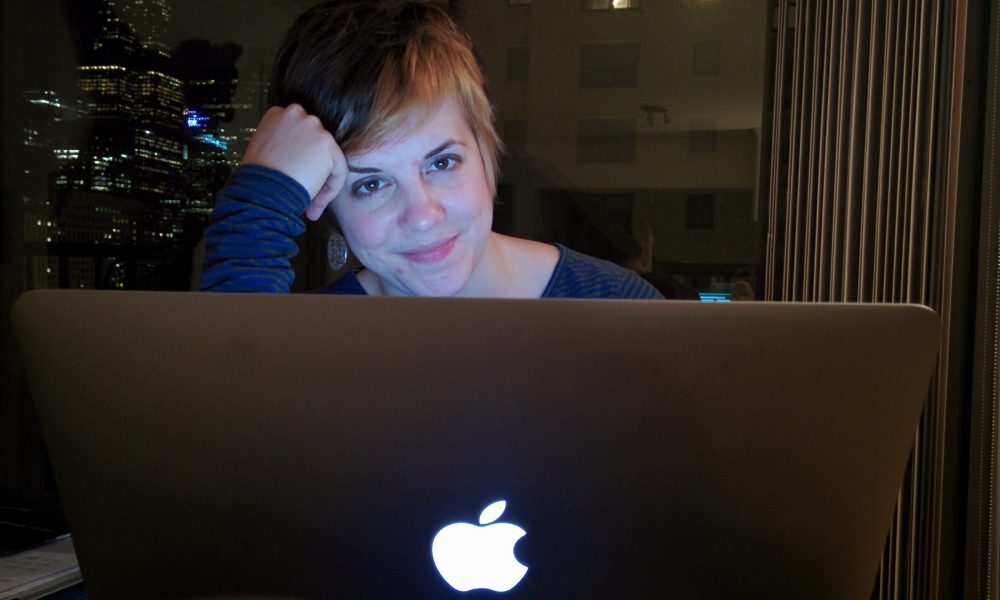
Today we’d like to introduce you to Katie Gore.
So, before we jump into specific questions about the business, why don’t you give us some details about you and your story.
My first job out of graduate school was at a SNF (skilled nursing facility), one of the most common settings for speech-language pathologists (along with schools). My patients were all geriatric individuals with neurological disorders that affected their speech, swallowing, and/or cognition.
Meanwhile, I also started contracting with a private practice that specialized in speech therapy for very young children (0-6yo). I told them that I enjoyed working with adults and would be interested in working with any older children or adults who may happen to call in.
Surprisingly, despite the fact that the practice’s emphasis was clearly pediatrics, a few adults did call for services, and I became their clinician. An architect with a lisp. A doctor with a stutter. These were young, energetic professionals with up-and-coming careers. Their speech concerns qualified as “mild”, by speech therapy standards, but the impact on their professional identity and communication potential was a significant concern to them.
I started thinking to myself: how many of these people are out there? Successful, educated professionals with “mild” speech-language-communication issues?
Who would you call, if you were lawyer with a language disorder, or a sales professional with a lisp? The vast majority of private speech therapy practices are aimed at young children, and those that aren’t are aimed at elderly adults with geriatric medical issues.
Your options for self-improvement are a nursery, or a hospital. But you’re not three years old, and you’re not sick.
And so, after finishing my obligatory first year at the SNF, I decided to develop my skills to serve this “invisible” group of people with communication struggles, those between the ages of 18-65.
Since I was barely a year out of graduate school, I thought the “responsible” career move would be to find an experienced practitioner who was already serving this demographic, and see if I could train under them for a while. I was surprised and perplexed when I couldn’t find a single practice in the Chicagoland area that fit this description.
So I did the only logical thing to do: with all of twelve months of practice under my belt, I started my own company. My spouse helped me build a website, I told a few old professors that I had a new practice, and put out my shingle.
While the general mission of the practice has always been to serve any young or middle-aged adult with communication struggles, I had found a special interest in stuttering.
Just a few months before I opened the practice, I reached out to the National Stuttering Association and to inquire about setting up a new self-help peer support group in downtown Chicago.
It was a crazy summer of diving head first into two major ventures with very little idea of what I was doing. I had met a grand total of two people who stutter, prior to leading my first support group for people who stutter. The first meeting of the City of Chicago chapter of the National Stuttering Association took place in May 2013. We had six people show up. A few months later, the first-ever speech IRL client attended a session, in my living room.
Fast forward four years. speech IRL now has a downtown office, with multiple therapy rooms, two full-time employees, a handful of part-time clinical contractors, and hundreds of clients served. In addition to speech therapy, we provide individual and group consulting services for large and small businesses. We have a nationally-recognized brand and receive inquiries and referrals from all around the United States.
Our NSA chapter (“the good NSA”, we call it), and the Chicago stuttering community at large, has similarly blossomed. Our database of member participants is nearly 200, with up to 50 people at individual events. We’ve hosted monthly meetings every month since 2013, as well as social gatherings, sporting events, interview skills workshops, and more.
The city of Chicago is hosting the NSA for their 35th annual conference in July 2018, which draws one thousand adults and children who stutter, along with families and friends, from around the United States and the world.
Along with all of this, my personal career has been a wild ride. I was elected to the Board of Directors of the NSA in 2016, in the role of Professional Relations Co-Chair. My volunteer leadership role is to educate other professionals– speech-language pathologists, teachers, psychologists, employers– about stuttering, and advocate for people who stutter. In November, I’m giving two invited talks on my specialty areas at the annual convention of the American Speech-Language-Hearing Association, which is attended by approximately 14,000 communication sciences professionals. (In graduate school they told us that nobody would take you seriously if you dye your hair strange colors, but I have not found that to be true.)
The whole journey has been exciting, amazing, and humbling. It’s also exhausting: constantly taking on ideas, projects, and risks that have no end or guaranteed outcome in sight, but trying it anyway. The fact is that none of this would have happened without community. At speech IRL, I meet daily with individuals who are challenging their anxieties and self-doubts, choosing to enter meetings and presentations and speak up, even if their voice sounds different or strange to the audience. And there is no greater community that will lead you to permanent outside-your-comfort-zone residence than the NSA. The vast majority of my community, friends, mentors, and role models are people who speak “differently”, yet are the most powerful speakers and communicators I know. Is there something you want to do that is hard, that you fear, that comes with a very real chance of failure and embarrassment and shame? Well, then you should do it. Now.
I’m in the midst of some pretty large sea-change projects, both for the NSA and speech IRL, and 2017-2018 is feeling a lot like summer of 2013. We have roadmaps but aren’t quite sure what the destination looks like just yet. I’m just thankful for our community: my practice team, our clients, NSA, and the friends we’ve made in Chicago. So long as whatever happens means working, growing, and self-challenging alongside others, I’ll be happy.
Overall, has it been relatively smooth? If not, what were some of the struggles along the way?
Surprisingly, yes. It’s been a SCARY road, so there’s been plenty of anxiety, but things have always worked out!
I’ve never had make-or-break goals. “If we don’t hit $X by Q3, we have to close.” I’ve been conservative with growth, and only stepped up to the next level once there was well-established traction and structure. I worked out of my home for eight months before renting an office. That was a big step, since rent is a significant business expense that I had never dealt with before, but the practice was solid enough that there was minimal risk of bleeding.
Sometimes, things haven’t been the smashing successes I’d hoped they’d be. We run a lot of group activities and programs, and its always anxiety-inducing, worrying about “will enough people show up”. Sometimes, the turnouts have been small. But, regardless, the few who do attend have excellent time. I don’t recall any specific failures, but I think it’s because I’ve learned to find the worthy outcome of any goal, instead of getting upset that it didn’t fit my preconceived hope.
Alright – so let’s talk business. Tell us about speech IRL – what should we know?
We are a privately-owned speech therapy and communication consulting firm. All of our staff are certified speech-language pathologist (SLPs).
We do everything from “traditional” speech therapy (diagnosis and treatment of communication disorders) to executive coaching to consulting and training for other professionals in related fields.
Our specialty areas are as follows:
Stuttering and speech fluency
ADHD and executive function (organization, time management, productivity skills, ability to focus)
Social communication (people who are socially awkward, often highly intelligent but struggle with “soft skills” and interpersonal interaction, and/or people who identify as having Asperger’s/high-functioning autism spectrum disorder)
Communication anxiety
Articulation (lisps, /r/, accent modification)
We are extremely non-traditional when it comes to our speech therapy methods. We employ a heavy counseling-based approach, and spend a lot of time exploring how anxiety, societal stigma, and self-identity plays a role in communication. It is impossible to describe a “typical” session, since they are all so different. Our main methodological ingredients are teaching, learning-focused discussion, counseling, and role-play. Ever wished you could replay a conversation in your head and fix something you said or did? That’s exactly what we do! We also employ a lot of mindfulness principles to enable to clients to “step outside their heads” in the heat of an interaction or exchange.
Communication skills aren’t rocket science: “slow down,” “use more pauses,” “don’t say ‘um,” but DOING them is remarkably challenging.
I think what sets us apart from the traditional speech therapy approach is that we don’t just make sure you can do X behavior or Y skill. We spend as much (if not more) time than getting to the bottom of *what gets IN THE WAY of you doing the thing you want to do. *
And, on the executive coaching and professional consulting side, I think what sets us apart is that our approach is based in the neuroscience and psychology of human learning. Executive coaching is a pretty saturated field, and frankly I’m not that interested in generic improve-your-body-language rule-based approaches. I prefer to teach clients how to ask their own questions, and then work through generating their own solutions. “What should I do with my hands?” Any number of things, there is no right answer! But let’s understand the social and physical science behind ALL the possible things you *could* be doing…which one do you think would work for you?
Any shoutouts? Who else deserves credit in this story – who has played a meaningful role?
Oh lordy. So many.
The first would be my spouse, John. I quit a full-time job to start a business, and he assumed the responsibility of the steady breadwinner. I still don’t bring home as much as I did if I worked elsewhere, because we’ve constantly reinvested back into the business. Four years later and he’s still encouraging it to thrive!
The second would be my first full-time employee, Courtney Luckman, who I’ve actually known since 2013. She contacted me out of the blue to ask if she could help co-lead our Chicago NSA chapter, starting with the second meeting. She was moving to Chicago from Charlottesville, VA, where she had just finished her bachelor’s degree. She had started an NSA chapter at University of Virginia and wanted to stay involved in Chicago.
Courtney was one of the first ten stutterers I ever met, and she is a passionate firecracker and advocate for people owning their voice, their vulnerabilities, and changing the world.
Her original life plan was to get a PhD in Primate Research, and she interned at the Lincoln Park Zoo for 1.5 years doing primate research. Along the way, she decided that speech-language pathology was a better career path. She left Chicago and went back to the east coast, attending the University of Maryland for graduate school. It just so happened that her graduation coincided with speech IRL’s first full-time employment opportunity. Taking on a full-time employee is a HUGE scary step, and honestly it might have been different if it was someone other than her. She calls me her mentor, but neither of us would be where we are if it wasn’t for our symbiotic relationship that started with a random e-mail.
Beyond those two people, I have to say my communities in general:
Family and friends: most of my Chicago friends are in the tech/entrepreneur/start-up world. Just hanging around reinforces growth, resilience, and openness to opportunities. I’m thankful to Josh Golden, a good friend, founder, and former CEO of Table XI (a consulting firm), who provided one of the earliest encouragements. We were at a wedding and I had to leave early, because I had work at the SNF the next morning…on a long weekend. He looked at me and said, “Ugh. You need to have your own practice. A year from now, you shouldn’t be working for anyone else.” Hearing that from someone who with a 12-year-old tech firm of 30 employees was a big boost. Josh also allows us to use the Table XI board room for our after-hours chapter meetings, going on four years now.
NSA/stuttering: literally hundreds of people who tell you to go do that thing you want to do, regardless of how challenging it is, every day. Too many to name.
Professional/SLP: being in a healthcare field where the entry-level degree is a 2-3-year master’s, there’s a lot of respect and clout held by “experts” who have practiced and published for decades. I was thunderstruck at how open and encouraging so many of these people are when I was first venturing into my professional specialty. I now have many friends who are decades older than me (a friend recently commented how weird it is that I have a lot of “old friends”) and encourage me by treating me like a peer, even though I’m 30 years less experienced than they. I have so much to learn but they are demonstrably eager to nurture the next generation.
Final credit to Level Office, the co-working space that I’ve been in since 2014. Level is an amazing community. Our physical location and the culture of the building has played a major role in speech IRL’s success. Level itself was a relatively new company when I first signed my lease, and they’ve since expanded to multiple Chicago locations and cities all around the US. Level is an amazing home.
Pricing:
- Average session cost (1-on-1, 60 minutes): $140
Contact Info:
- Address: speech IRL
73 W Monroe, Suite 227
Chicago, IL 60603 - Website: www.speechIRL.com
- Phone: 312-870-0352
- Email: info@speechIRL.com
- Facebook: https://www.facebook.com/speechIRL/?ref=bookmarks
- Twitter: https://twitter.com/speechIRL


Image Credit:
Katie Gore
Getting in touch: VoyageChicago is built on recommendations from the community; it’s how we uncover hidden gems, so if you know someone who deserves recognition please let us know here.


