



Today we’d like to introduce you to Anu Mahajan.
Anu, let’s start with your story. We’d love to hear how you got started and how the journey has been so far.
TinkRworks was actually formed as a result of a discussion I had with my younger son, Ravi, who was 8 years old at the time (he is now 11). Amazing how an 8-year old can inspire the creation of a company!
Back in 2014, I vividly remember driving on a rainy day with both of my boys in the car. I was driving Rohan, my older boy (now 13 years old, but back then, 10 years old) to a laser-tag birthday party. After dropping him off, the rain began to come down harder and I told Ravi that rather drive in the pouring rain, that we were going to go grab lunch somewhere while the rain subsided. We ended up going to a Panera Bread and the two of us sat down for what proved to be a life-changing lunch for me.
As we sat down to eat, I said to Ravi, “let’s chat about school.” Like all children, Ravi moaned and responded, “do we have to dad?” I told him we did and proceeded to ask him about his favorite subjects in school. He quickly rattled off the subjects in his order of preference for them, and science and math ranked 2nd to last and last, respectively. This came as a complete shock to me as Ravi was quite good in these subjects.
When I asked him why math was his least favorite subject, he said, “Dad, it’s SOOOOO boring! We never do anything interesting.” I asked him about what they were currently doing and he said that they were measuring angles and measuring distances. When I asked him how they were doing it, he responded by talking about rulers and then also made reference to protractors. When he mentioned this, I could easily understand his lack of excitement, as this was the same way that I used to perform these tasks, it was the same way my parents used to perform these tasks, and I’m fairly certain it was the same way that my grandparents also performed these tasks. Ravi was right–it was pretty boring (no offense at all to the teacher!).
So, I turned to Ravi and said, “So how about if we do things a little differently? How about if we go home and design a video game together where you are this worm who is encased in dirt. And, in the dirt there are insects that are trying to eat you and rocks you must avoid. Your goal is to make it to the top of the soil to see the sun, but there’s also a farmer who is sowing seeds and you must avoid him as well, as otherwise he could harm you.”
Ravi immediately perked up and said, “we can do that? We can go home and design a video game?” I told him that we could definitely do so. He then strung together 10’s of questions in rapid progression, excited as heck about the notion of designing a video game. He was so excited that he barely gave me enough time to respond to any of them. Questions he asked included, “Dad–can I color my worm any color I want?” “Dad, can we create this game in a single day?” “Dad, do we need anything else besides our computer to do this?” “Dad, can we make it a two-player game as well?” He just asked question-after-question for a couple of minutes, at which point, he stopped and said, “Dad, this is really cool, but what does this have to do with math and angles and distance?”
I then told him to imagine that he was the worm and that he was using the controls to avoid an insect and in doing so, was moving closer to the rock. I asked him, “Ravi, what happens as the rock is approaching?” Ravi responded, “well, the distance to the rock is decreasing.” “Right”, I said, “and what happens when you hit the rock?” He said, “well then I die.” “That’s right” I responded, and then asked, “but what happens to distance?” Ravi immediately said, “the distance to the rock is then zero.” He then got a big smile on his face–I don’t think I’ll ever forget it as he really got it.
He said that he understood, that he had to move away from the rock before the distance got to zero otherwise he would die. He didn’t know it at the time, but he had just formulated a conditional statement which is something used all the time in coding.
Next, I asked him, “what do you do before you hit the rock?” He said, “Dad, I need to turn away.” I told him he was right and asked him how much he would need to turn. He quickly started drawing 90-degree angles in the air to which I asked him, “that’s right–what angles are you drawing?” He responded immediately and said, “90-degree angles.” I then said, “see…math is used all the time in video games, but you just don’t know it.”
He again asked another string of back-to-back questions in rapid succession asking things such as whether we could start the minute we got home, if he could create special insects, and a whole slew of other questions. Out of nowhere he then said, “Dad, can I have my friends come over and also create the game with me?”
I was stunned by the request and said, “do you think that they’d be interested?” to which he replied “Dad, they would LOVE something like this!” This really stuck in my head.
The next day, I called up my business partner and co-founder of TinkRworks, Gil Levendel, and said to him that I want to run an idea by for a start-up company–one that focuses on enhancing the problem-solving capabilities of children by using technology to allow children the opportunity to apply what they learn in school. Gil thought it was a great idea and we decided to take the next steps.
Well…after a year of research, writing a formal business plan, raising funds, and quitting our “day jobs” TinkRworks became a reality. In our first 13 months of operation, we engaged with >500 children, started holding after-school sessions in numerous schools in the western suburbs of Chicago, and held summer camps that have been >95% filled to capacity across the summer. We now have strong interest from investors on the east coast, the west coast, and even at the international level, which is crazy to think, as things seem to be moving at light speed.
All of this because of a lunch I had one day with my then 8-year old son and a simple question he asked.
Has it been a smooth road?
Though we’re happy with where we currently stand, the road has not always been smooth, similar, I’m sure, to most start-up efforts. I would say that to date, although we’ve faced a number of challenges, there have been three struggles that really stood out, especially in the first year of the company, namely: 1) developing marketing awareness, 2) performing technological development, and 3) finding the right balance between staffing volume and number of projects we wanted to run. Let me talk about each of these.
The first challenge we faced was really getting the news out about what we were doing.
We knew that we wanted to put together something that we felt was unique and needed, but we really had no idea of how best to get the word out. In fact, for the first almost 8 weeks, all we did was develop our “story”, i.e., who we are, what we do, why what we’re doing is important, etc. This literally involved a ton of writing, re-writing, more re-writing, reviewing, and then even more re-writing. Once we were satisfied with the story we put together on paper, we got our web page up and waited or people to start calling us and…no one called! We realized that just because we have a great story (or at least we like to believe we do), it doesn’t do anyone any good unless they know about it. So, we then decided to embark upon a grass-roots campaign where we enlisted all of our immediate family members and friends and asked them to start telling their friends all about us.
Additionally, we decided to hold projects at reduced rates at community centers to show people what we were all about. I have to say that our wives and their friends were immensely helpful and effective in this early stage (and they still are today!). They took it upon themselves to tap into the proverbial “mom’s network” and get news out about us. As a result of this grass-roots campaign, interest started growing about us, calls started coming in, and web inquiries started cropping up.
In all honesty, we had absolutely no idea how hard it was going to be to get the news out, and we could never have done so without the help of our family and friends–they were the reasons why interest levels started to rise.
Development of needed technology to support our vision and the projects we wanted to create was also a challenge–a much larger one than we thought. Gil and I are co-founders of TinkRworks and our technical backgrounds complement each other quite well. In my case, I’m an electrical engineer and worked in R&D for several years and have a large degree of familiarity on the hardware side. Gil also stems from a hardcore tech background, but on the software side, as he hails from the world of computer science. Between the two of us, we thought it’d be no problem to start churning out projects for our students using applicable technology but we quickly found out that ramping-up was far more difficult than we could ever imagine, we literally had to amass over a hundred different suppliers to meet our needs for parts, procurement times, costs, and of course, quality. Add to this that we needed to figure out how to get all of these electronics to link together and talk to each other (via software) was just a huge undertaking that we didn’t realize. We poured countless hours in developing the technology that we now use, and we’re extremely proud of it. If you walk into our center now, you’ll literally see hundreds of electronic parts on our shelves that TinkRers use as part of their projects and are readily able to code them up in a way to get them to communicate with each other. It’s all seamless now, but it literally took us thousands of hours (seriously!) of development to get it to this state. The good thing is that Gil and I are highly passionate about technology so though it was intense work and highly stressful, it was incredibly fun as well!
One other challenge we faced–and it was a large one–was determining the right number of Team members to have on our staff. When we started, I personally had incredibly high aspirations and wanted us to develop an extremely diverse and comprehensive portfolio of projects right out of the gate. I pushed the Team *VERY* hard to implement this and as a result, across the board, Team members worked to the point of exhaustion, putting in countless hours, 7 days a week. Imagine this–in our first year, with a Team of 6 individuals, we created 33 projects for our center, 14 unique summer camps (our camps are full-week camps, spanning 37.5 hours each), roughly 6-8 different projects that we ran at schools, and of course, we taught each of the above. In addition to the creation and delivery of this content, we also attended 10’s of STEM and STEAM expos to help get the word out about us, supported numerous schools in their science fairs and STEAM-activity nights, and also provided in-school STEAM projects for children as part of their science-week activities. The Team did it all–and did so in stellar fashion–but the shear load of the work just crushed us all. As we now move forward, we’re growing our Team and also working diligently to ensure that we rightsize our development & delivery efforts and in the process, working to ensure that we allow one another to have suitable work/life balances which is critical.
So let’s switch gears a bit and go into the TinkRworks story. Tell us more about the business.
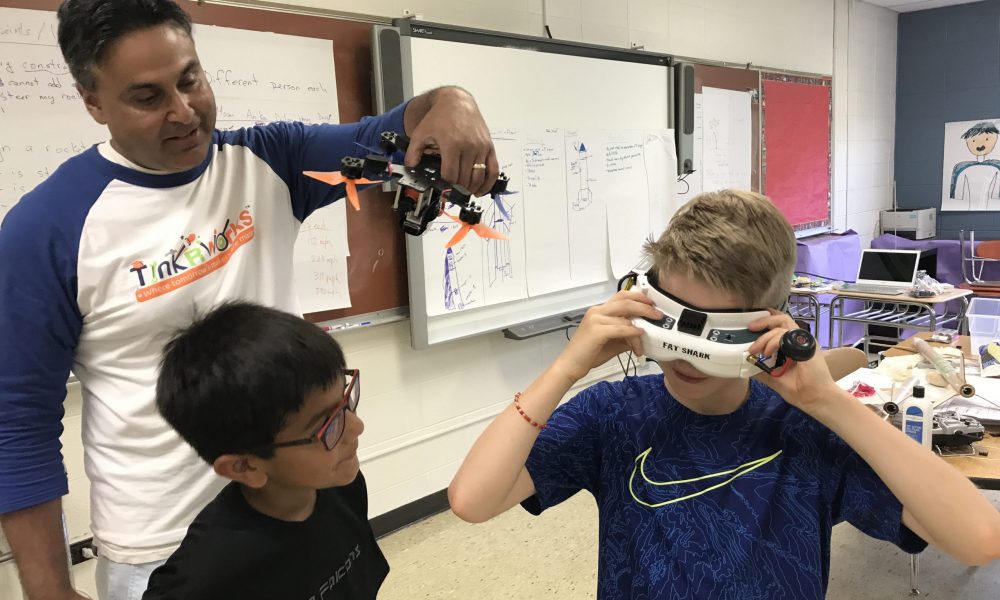
TinkRworks is a new and innovative provider of exceptional STEAM (Science, Technology, Engineering, Arts and Mathematics) experiences for children aged 6 and beyond, who we refer to as “TinkRers.” Our experiences are designed to:
-Foster a love of creating
-Enhance problem-solving skills
-Reinforce and expand on concepts and ideas taught in school
-Provide delight and inspire curiosity
-Encourage self-expression
We carefully craft each experience to build on and go beyond what’s taught in school. This reinforcement helps TinkRers bring to life what they learn in the classroom in deeper and more meaningful ways.
Our approach immerses TinkRers in project-based settings where they are faced with challenging problems to solve. Using combinations of 21st century skills (e.g., coding, 3D- printing, electronics) and traditional skills (e.g., woodworking, painting), TinkRers embrace these problems and tackle them head-on, achieving beautiful results along the way.
How do you think the industry will change over the next decade?
I see significant growth in this industry–specifically STEAM education–over the next several years. In fact, I feel that we’re in the embryonic stage at the moment as there’s a large gap between what traditional schools are teaching and what employers seek, which represents large amounts of opportunity for a variety of different players and different solutions.
If you look at schools, the overall approach in regards to teaching and subject focus has remained relatively static since roughly the industrial era; overall focus continues to be on foundational subjects such as mathematics, science, language arts, social studies, etc. Schools continue to teach in this manner and instill within the students the fundamental knowledge of these subjects which in my opinion, is both highly valuable and highly imperative. However, today’s employers are searching for something more than foundational capabilities that arise from knowledge of these subjects.
In fact, the needs of today’s employers are evolving dynamically, driven in large part by the technological boom of the past couple of decades, which has led to improvements in efficiency and effectiveness of operations. When talking to employers today, the capabilities they seek revolve around a different set of dimensions. They will openly talk about the strong need for their employees to have strong problem-solving skills, elevated critical-reasoning abilities, and a foundation based on analytical thinking.
Schools are working diligently to modify their curriculum to incorporate elements that will address these newly-sought dimensions, but they cannot change overnight–change takes time. As a result, a gap currently exists between what is being taught and what is being sought. And, as numerous employers, scholars, educators, administrators, and parents point out, this gap is only expected to grow before it gets better.
Thus, to those who work to close this gap–including TinkRworks, of course–a real opportunity exists. Am I worried that others might step in and also get in the game? Not at all, as I think that this is a very large problem that needs to be solved and in the end, the playing field is large enough to support a number of players and also a number of different solutions. Naturally, though, for understandable reasons, I do think that TinkRworks has a great shot at being one of the premier players in this space, both now and in the future!
Contact Info:
- Address: TinkRworks
21 W. Second Street, Suite 300
Hinsdale, IL 60521 - Website: www.TinkRworks.com
- Phone: 708-401-5956
- Email: info@TinkRworks.com
- Facebook: https://www.facebook.com/TinkRworks/


Getting in touch: VoyageChicago is built on recommendations from the community; it’s how we uncover hidden gems, so if you know someone who deserves recognition please let us know here.


Liz
September 18, 2017 at 6:13 pm
My 11 year old daughter has been a participant in the TinkRworks programs for about 2 years now. She started with the in-school sessions and loved ithem so much, we enrolled her in the after-school sessions and 2 summer programs.
We know Anu Mahajan very well through TinkRworks and he is an amazing instructor who and person. As is Gil.
My daughter’s excitement for TinkRworks developed much in the same way as Anu described his son’s excitement for STEAM developed. She had a passion for video games, but never made the connection between coding/video games and STEAM. TinkRworks helped her make this realization and encouraged her excitement for learning and exploring to her fullest potential, which she continues to do at TinkRworks!
This past summer, she attended 2 weeklong TinkRworks day camps:
Minecraft and Drones. I cannot adequately convey how much she enjoyed both camps! The projects! The instructors! The kids! She was in STEAM heaven! She has her drone (coded and made by her) on display in her bedroom and proudly shows her friends how it works. My husband and I are so excited by her passion for STEAM, which TinkRworks introduced to her. She now says she wants to be a computer engineer when she grows up.
TinkRworks has been an enlightening delight for our family and we look forward to our daughter continuing to learn and have fun with their exciting and innovative programs.