



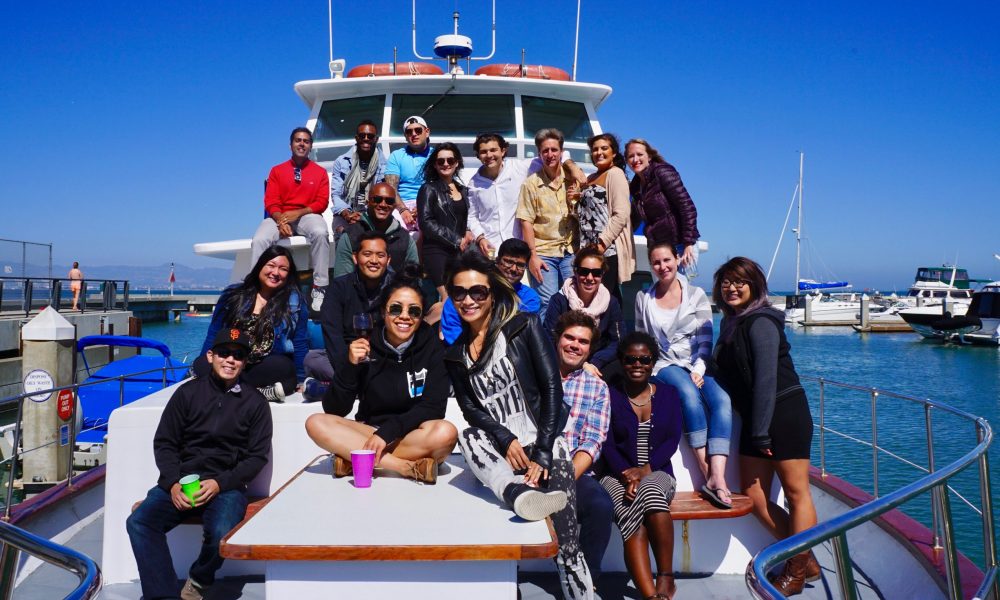
Today we’d like to introduce you to Ajay Prakash.
So, before we jump into specific questions about the business, why don’t you give us some details about you and your story.
In early 2013, my co-founder James Joun came to me with the idea of starting a company in clothing care and the story of Rinse began.
James has been one of my best friends since college (I’ve known him for 18 years now), and has always been someone I viewed as a potential co-founder. He also had the unique advantage of being raised in dry cleaning. He wanted to start a company to help address the pain points of existing dry cleaners, which he understood intimately. At the same time, I was already working on a few ideas to remove friction from the customer experience of necessary and recurring services. Over breakfast at Union Cafe in Cow Hollow, Rinse was born.
Since the early days, the consistent theme James and I have heard from both customers and cleaning partners alike is that they are experiencing significant friction.
We now refer to the friction customers experience in clothing care as “death by a thousand cuts” — there isn’t just one big point of friction we need to remove, but many points across the entire customer experience. For example, in dry cleaning, (1) you don’t actually know who’s a good cleaner, you just go to the nearest one; (2) you can’t assess quality until after you get your clothes back; (3) cleaners typically operate during normal business hours and are closed on weekends, which makes pickup and drop-off inconvenient; (4) there is limited transparency, limited customer service, and limited technology-enablement.
Cleaners also experience their fair share of friction. Most cleaners are underutilized and do not know how to drive more volume. Historically, foot traffic was enough to acquire customers, but times have changed. When customers do walk in, there is limited incentive to invest in customer service or technology because the main focus is on paying the bills.
With Rinse, our goal has always been to remove the friction on both sides. For our customers, we are systematically dismantling the “thousand cuts” by providing one simple solution for everything in their closet. For our cleaning partners, we send a predictable and steady stream of volume and enable them with technology to help ensure the highest quality cleaning for our customers.
Our success to date is a reflection of our team’s hard work; our cleaning partners’ dedication to quality; our Valets’ work on the front lines of the customer experience; our investors’ incredible support; and our customers, who use us, love us, challenge us, and continue to make us better.
Rinse will continue to do right by everyone involved by staying true to our core values, investing in the growth and development of our team, and creating a world-class service that our customers will enjoy for many years ahead.
Overall, has it been relatively smooth? If not, what were some of the struggles along the way?
We launched in 2013, at a time when it seemed like every consumer service start-up chose to be “on-demand,” due in large part to Uber’s success. VCs were excited to find the next Uber and companies were launching on-demand services in all verticals imaginable (more broadly known as “Uber for X” companies). Fast forward to today where a few companies have found success with the on-demand model, but many more have struggled. In the past year, we’ve seen a handful of well-funded startups with strong teams either going through layoffs or shutting down entirely.
Rinse took the approach of focusing on “smart scheduling” and quality instead of “on-demand” and speed. We realized that Uber was solving an acute pain point — if you need a taxi, you need it now — where an on-demand model made sense to remove the friction.
Rinse, however, is solving a chronic pain point — you always have dirty clothes — and customers almost unanimously prefer quality over speed, and crave consistency and predictability.
Quality is the most important component in clothing care to earning a customer’s trust.
On-demand emphasizes speed and faster turnaround times and comes at the expense of quality, because items are pushed through the cleaning process too quickly. Smart scheduling prioritizes quality over speed.
Consumer service companies are difficult to build. On the demand side, they are often dealing with personal items from each customer, meaning expectations are always high.
On the supply side, operational complexity increases significantly with scale. Given that, it’s critical that companies choose wisely up front when addressing consumer pain points and making core business model decisions. If the pain point is acute, “on-demand” might make sense. If the pain point is chronic, which is the case for most companies, a focus on “smart scheduling” and quality is almost always a better approach.
Please tell us about Rinse.
At the very basic level, Rinse helps customers get their dry cleaning and laundry done by offering pickup, high-quality cleaning, and delivery for all items in their closets.
Our mission is to become the first and largest national brand in clothing care. We are more confident and excited than ever that we are moving in the right direction to becoming a household name. Rinse has grown at double-digit month-over-month rates since inception.
Our customers love our service, which has led to a loyal customer base.
We have built a business with attractive economics to help ensure long-term sustainability.
We are also getting stronger with each new city. Rinse Washington, DC, which launched in late 2016, has seen 40% month-over-month growth and was contribution margin positive after only three months on the ground. We expect to see faster growth in Chicago, which we officially launched a few weeks ago.
Our approach to smart-scheduling and smart growth is what we feel drives our customer loyalty and fuels our relationships with our cleaning partners.
If you had to go back in time and start over, would you have done anything differently?
I think every startup founder, on some level, wishes that important learnings could have been made more quickly or less painfully (or both). While I can’t point to anything major that we would have done differently, there have definitely been small learnings along the way.
Contact Info:
- Address: Rinse, Chicago
1918 N. Mendell St., Ste 100
Chicago, IL 60642 - Website: https://www.rinse.com
- Email: help@rinse.com
- Instagram: https://www.instagram.com/rinse_inc/?hl=en
- Facebook: https://www.facebook.com/RinseNow/
- Twitter: https://twitter.com/Rinse
- Yelp: https://www.yelp.com/biz/rinse-chicago


Image Credit:
Phil Stockbridge
Getting in touch: VoyageChicago is built on recommendations from the community; it’s how we uncover hidden gems, so if you know someone who deserves recognition please let us know here.


