



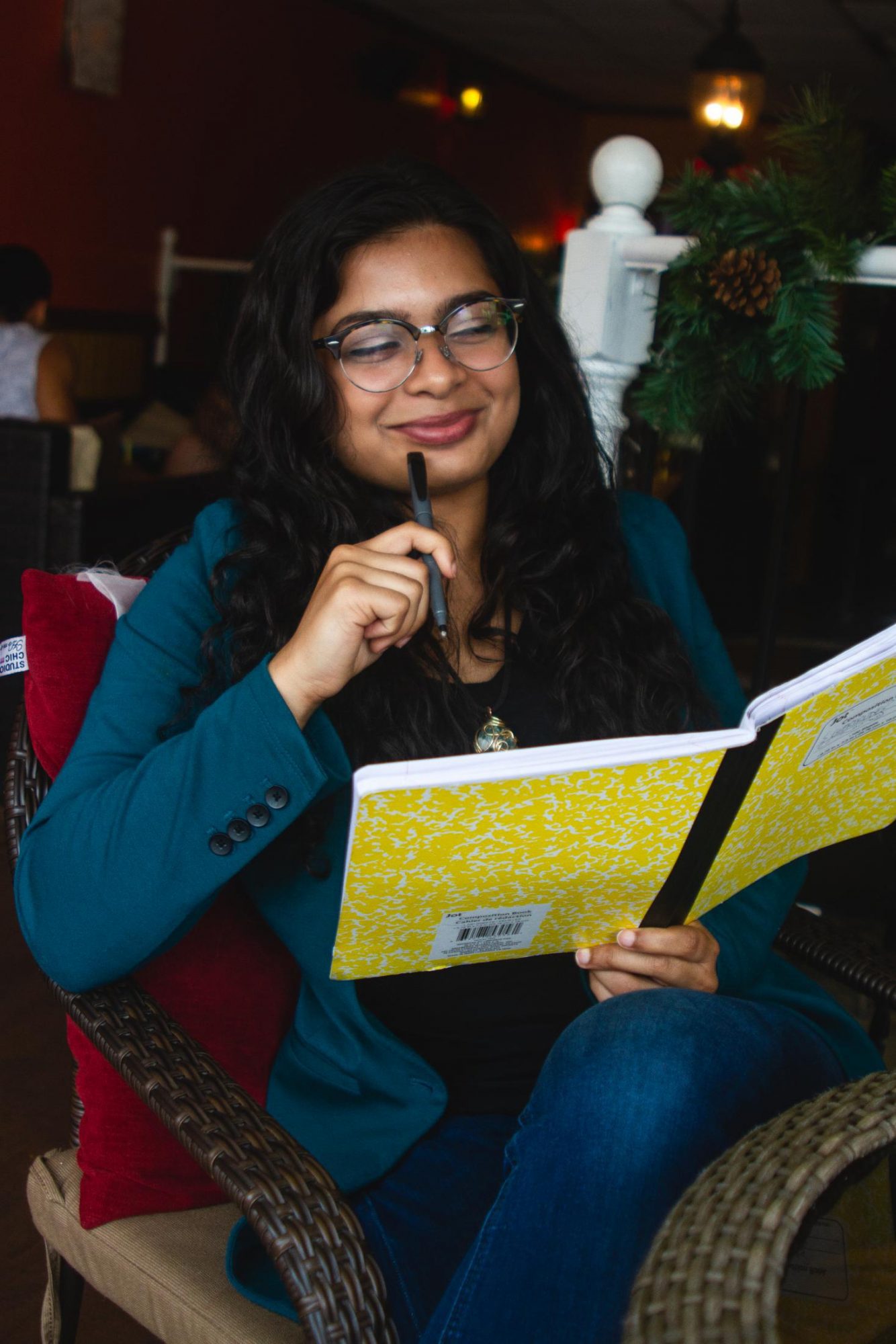
 Today we’d like to introduce you to Jessica (aka Gertrude) Mascarenhas.
Jessica, we’d love to hear your story and how you got to where you are today both personally and as an artist.
For me, poetry was a side effect. It was a response to growing up in an abusive environment because although I love being Indian, part of that culture includes abnormal amounts of suppression, secrets, and not showing emotions. After I moved out, I realized most of my life was a lie and the only times I was allowed to be myself was through my music and writing, and that was one thing no one could take away from me. I learned the value of food, money, and academics, but never the value or worth of my own life. I think this is often the case with first generation Americans. You grow up learning how difficult your parents’ lives were back in their country that you feel anything other than gratitude for them is disrespectful. You also forget that you are just as American as your peers and have the right to fight injustice here, even if it is within your own home. I was in and out of rehab for years due to my unstable home life and the only thing which kept me going was my drumset, piano, and notebook. I had to remind myself every day that one good thing has to come out of all the pain I have endured in my life so I sat down and forced myself to write every day. The angrier I was, the better the poem. This anger consumed me but the moment I decided to stop blaming people for my life was when the course of it shifted. When I put something in a poem, I try to leave it there. I started going to open mics every week and met people who had different pain than mine but still heard me when I said my truth. We are all supportive of each other and I am constantly in awe and inspired by the talent here in Chicago. I have found a new family in my fellow poets and artists and I wouldn’t have it any other way.
My current project is a book of poems about my life, but mostly about being a first generation kid and my complicated relationship with America. At the end of the day, I know I would not have the same opportunities if I grew up in India, and for that I am grateful. However, my family was the first non-white residents to move onto our block in the suburbs. I was five years old when a white girl at school told me she couldn’t be friends with me because we weren’t the same skin color. Those little moments along with old white folks not shaking my hand at church were damaging at that age. I remember scrubbing at my skin in the shower because a boy told me it had dirt on it. The reason I write poems about racism is not only for my five-year old self who wished she was white, but for every kid who felt that way. On the other hand, if I grew up in India, I wouldn’t experience that level of racism but I would also probably be in med school right now. I am the first in my family to pursue something in the art field so I definitely keep a reminder to count my blessings. It still kills me to this day though that when I was ten I shaved my eyebrows and hair because I thought they were too thick and made me ugly. I want to be that voice who shakes these children furiously and yells at them before the razor blade touches their beautiful scalp, “YOU DON’T HAVE TO DO THIS!” because I know I wasn’t the only one and there are probably millions of kids in their bathroom right now thinking this.
I am now unapologetically and overly proud to be Indian, to have inherited my father’s unibrow, to have inherited my grandmother’s loud sneeze, and to have inherited my mother’s big feet. I am so proud to be brown that I look at young people of color now and wonder how the hell at some point in my life I ever felt I was anything less than beautiful. I still struggle with this today and so I know we need to start with the youth. Thankfully, things have progressed since I was a kid. We have people to look up to like Mindy Kaling, Hasan Minhaj, Rupi Kaur, Dev Patel, Aziz Ansari, and Kumail Nanjiani to name a few. We are no longer just side characters to America. We have become the main cast and we will tell the story from our point of view now. My poems are love letters to people of color, especially children. They are also public service announcements to people who are not of color, just as a little reminder.
I realized I can’t cure ignorance but I can write a whole poem about it and hopefully, make people aware and more cautious of how they treat people who are unlike them. Being a first generation American is an underrepresented narrative in this country and something I struggle with a great deal. Balancing my American and Indian identity without compromising parts of myself is still a challenge for me even now. People don’t realize India has one-thousand five hundred and seventy-six languages, (that we know of). I live a block away from Devon and no one here speaks the same language as my family. Ever since I moved out, I have no one to speak in my native tongue with except over the phone with my grandma or aunt. I am not fluent in my language and I feel further away from it every day. One of the ways I can stay connected is through cooking. Even if my poems are about racism or breaking up with a boy, somehow there’s always food in them. I think I just miss my family’s cooking. There is so much that needs to change with my people and my culture but one reason I wouldn’t trade being anything other than Indian is the food. People here associate our food with a pungent odor. For me, just smelling a jar of mango pickle causes me to salivate. The smell of masala dosas, chai tea, and fish fry was enough to wake me up in the morning and it was the best alarm clock a kid could ask for. My mother would always light candles and open windows even if it was freezing cold outside just to get rid of the smell. She would take all of our jackets and keep them in a room with the door locked because she didn’t want her cooking to linger with us on school buses or at workplaces. I realized my mother’s cooking was the best scent in the world to me and now I miss it every day. My mother, grandmother, Mai, and my Aunt Theresa are all scientists when it comes to the kitchen. I guess Indian food for me can be considered a political statement. It means I am done code-switching and done being openly American and a closeted Indian. It means I will honor the women in my family, my culture, and my ancestors through food. Although I may lose my language, these recipes are something I will always have. This is the main way I stay grounded to my roots at this moment because although my aunt is halfway across the world right now, she can still send me one of her recipes and I can have her right there in the kitchen with me when the shrimp curry is simmering on the stove. It brings me right back to India and to her. I can spend my whole life writing poems about this unexplainable feeling and still never do it justice. I’m still going to try.
We’d love to hear more about your art. What do you do you do and why and what do you hope others will take away from your work?
Right now I’m in touch with my poet side, but I was a musician first. I started playing piano at the age of five and drums at ten. Then I discovered artists like Nas, Tupac, and Ghostface Killah and have been attempting to rap and play the drums simultaneously ever since. One day I could be working on my creative non-fiction book about addiction, the next day I might crank out five poems because someone said something slightly racist to me on the train, and the next day I may sit in my room for hours trying to perfect a song on the guitar. Every form of art serves a different purpose to me. I had all this anger as a child and playing the drums allowed me to physically let it out. My sadness rang out melodies on the piano and guitar. My thoughts were always for the pen and paper. I treat them like they’re my children and tell them individually they’re my favorite but in reality, I love them all equally.
I create art for the child inside all of us, (especially my five year old self), who feels neglected, unheard, misunderstood, and who feels like a weirdo. I do this for people of color to relate to and for people who are not of color in hopes they find an ounce of empathy or understanding. I hope first generation kids, no matter where their heritage may lie, find a poem of mine which resonates with them. I hope it inspires at least one Indian kid to apply to art school instead of med school. I create art because it’s the best way I know how to be myself unapologetically and unfiltered. One time at an open mic, I saw a man with watery, bloodshot eyes walk into the audience. He looked like his day couldn’t get any worse. While I was performing a poem called, “Fluent in American,” I saw him laughing. When I was leaving he said “thank you,” and what this man doesn’t know is this interaction meant more to me than it did to him. That feeling is everything to me. The ability to move someone or make someone think again is something I take seriously. I want people to know I have so much growing to do myself and every day I am aware of that. Sometimes I need a break from creating to recharge and heal and I, too have to remind myself that it’s okay to step away as long as I eventually come back. I now know my story in its entirety is painfully important and needs to be told, and I’m just here learning how to do it justice.
Have things improved for artists? What should cities do to empower artists?
I think conditions have improved but I also know how many talented kids grow up in Chicago but never have access to resources to fund their dreams. Joining poetry club in high school was a game changer for me. Finding the community of Young Chicago Authors and competing in LTAB replaced so many negative habits and addictions in my life that I’m forever grateful for. Although my home life wasn’t ideal, I had access to an after school program which allowed me to be safe for a couple hours longer. A lot of kids in Chicago have similar situations at home, but then they go to a CPS school where the administration doesn’t care about them or provide resources to cultivate healthy, productive ways to express themselves. I now know how lucky I am to have found this community and will do my best to contribute and give back to a city which has given me a safe place to be myself. I say this very unbiasedly and only because it’s true, that Chicago breeds the most talent out of any city in America. We are fully aware this is the windy city of adversity, segregation, violence, racism, beautiful art, beautiful buildings, beautiful people, rich history, revolutionary leaders, and most importantly, this will always be home.
The City of Chicago can help by funding more programs and spaces for young people to express themselves in healthy ways.
Do you have any events or exhibitions coming up? Where would one go to see more of your work? How can people support you and your artwork?
Instagram: gertrude7_11
For updates on the release of my book and performances in upcoming performances in the Chicago area.
Contact Info:
- Email: jessemascar@gmail.com
- Instagram: gertrude7_11
Image Credit:
Photo credits: Jeannette Jakupi & Michael Khoshaba
Getting in touch: VoyageChicago is built on recommendations from the community; it’s how we uncover hidden gems, so if you know someone who deserves recognition please let us know here.


