




Today we’d like to introduce you to Dorothy C. Straughter.
Dorothy, we’d love to hear your story and how you got to where you are today both personally and as an artist.
I was introduced to quilt ethos in November of 2014 by Marcia Thomas who presented her Underground Railroad quilt. I realized, I did not know this part of American History. I then embarked on a historical journey woven through numerous works which include my own Underground Railroad, Great Migration, and American History Quilts© (Negrobilia).
This serendipitous jaunt into the quilt world pushed beyond a foundation of skills as an occupational therapist. With a background in research that studied assessment of line, color and form as it relates to the learning process and the development of strategies of instruction for the specialized population my imagination to design was excited. Teaching neuroscience, disease processes, research and a Master’s Degree in Biological Sciences grounded in genetics, facilitated skills that allowed for the portrayal of psychological impact on human form and function.
I began to inhale the history afforded by the Edward J. Williams collection at the Stony Island Arts Bank which depict African Americans, Asian Americans and women in demeaning caricature and became enthralled by its content. These caricatures informed by continuous research equipped me with historical perspectives difficult to find in other venues. The study in numerous dance genre including ballet with Mr. Joel Hall added to the neuro-kinetic mechanisms that support the impact of humans in motion. They are interwoven in my quilts.
I am Passionate about this work that illustrate the ugly parts of American history. Appreciating history invigorates my resolve to purvey historical truth. This multifaceted quilt architect evolution continues to stitch itself through the fabric of time illustrating theoretical frameworks imprinted in the context of textiles. My quilts have been featured in the following venues:
My work has been featured at the Quilters Trunk, Chicago Public Library, the Beverly Art Walk, an event conceived by the Beverly Arts Alliance, private home viewings, Hyde Park Art center, the Midwest Buddhist Temple, the Chicago Home Arts Theatre, Beverly Arts Center, the Castle, The Art Institute of Chicago, and School of the Art Institute of Chicago. Featured articles include the Beverly Review, DNA Info, the Villager, and The Patch. I have been interviewed on WVON radio AM1690. She has been interviewed by the Tribune ARR
We’d love to hear more about your art. What do you do you do and why and what do you hope others will take away from your work?
I have serendipitously become a quilt historian, don’t know how it happened as I have no previous sewing skills other than winning a simplicity contest in 1976 as a consolation for being in a Junior Miss pageant. I had not sewn since then. I quilt the ugly parts of American history as depicted in advertisements of the 17, 18 and early 1900s.
What do you make?
I create quilts that are large in scale. It is the “In Your Face” approach to art.
What do you create?
They are reported by others to have a 3 dimensional quality.
How do I create them? I use a Futuro 950 sewing machine that my mom gave me and used when she made our clothing when we were children.
Why do I create them? I create them because this is the American history that needs to be told. It no longer needs to be quizzed as African American history as it is integral to the American Historical Landscape. It need not be segregated into one short month. This history needs to be expressed with all history as history has no gender or color and that Africans were not enslaved, blacklisted, shamed, marginalized, turned down for jobs, ridiculed, lynched and abased only during February. Being black in America it is a part of daily life the ancestors and as well African Americans live. I create them because they are representative of the ugly and the beauty of ALL people. I love oxymorons.
What is the message? Through triumphs and tribulations many genetically defined groups culminating in only one human race garnered a troubled relationship resulting in a dynamically appalling and inexcusable past. This in your face approach presenting racist stereotypical advertisement depicting African Americans in demeaning caricature spawned great migrations. It is part of the American historical landscape. These works show racism in its violence, and misogynistic attitudes that evoke profuse rage. They show innumerable forms of what is repulsive, hideous, and disgusting. Yet they show the strength and beauty of a people who endured through and to prosperity.
What do you hope people will take away from it?
Displaying these artifacts complete with their preposterous stereotypes, are revolting, yet beautiful. Still, they remain in the thoughts and minds of individuals who harbor fondness for this past as to keep these images and the plight of those they depict as the status. Careful examination helps us reflect this past on to today’s society and shows how Americans need to evolve thought patterns on race relations. We need to inspire future generations to forge for truth in history.
What should we know about your art work?
They are all important pieces of an ever- evocative past. Lest we never forget this past only to learn and glean so that we can push rich academic conversation forward about race in America and purge the genetic pain generated by millennia of oppression suffered by lineages of African origin. With respect to variation in thought surrounding this subject matter, we need to own this history and make no excuses for the journey we take to learn and appreciate this part of American history. Analyses that move the conversation forward to resolutions are welcome.
Artists face many challenges, but what do you feel is the most pressing among them?
Finding and defining their voice.
Do you have any events or exhibitions coming up? Where would one go to see more of your work? How can people support you and your artwork?
Past exhibitions:
Beverly Art Center (x3), Hyde Park Art Center, Art Institute of Chicago (x2), School of the Art Institute of Chicago, Midwest Buddhist Temple the Chicago Home Arts Theater, the Castle and Dorchester arts Housing Collaborative.
News articles are in the Beverly Review, DNA Info, the Villager and the Patch.
Radio interviews include Peri Small and Art Chatdaddy Sims on WVON radio AM1690 ARR
Future Venues include: Stony Island Arts Bank Celebrating Life Historians (Honoring Octogenarians) (August 4th 2018)
Future articles: The octogenarian Brunch with the Patch newspaper.
Quilting Arts | Modern Patchwork | Quilting Arts TV
How can people support my work? Read the articles, Go to the galleries, like “American History Quilts” on the Facebook page. Purchase a quit.
Contact Info:
- Email: Straughterdorothy@yahoo.com
- Facebook: American History Quilts Azari (Dorothy Straughter)
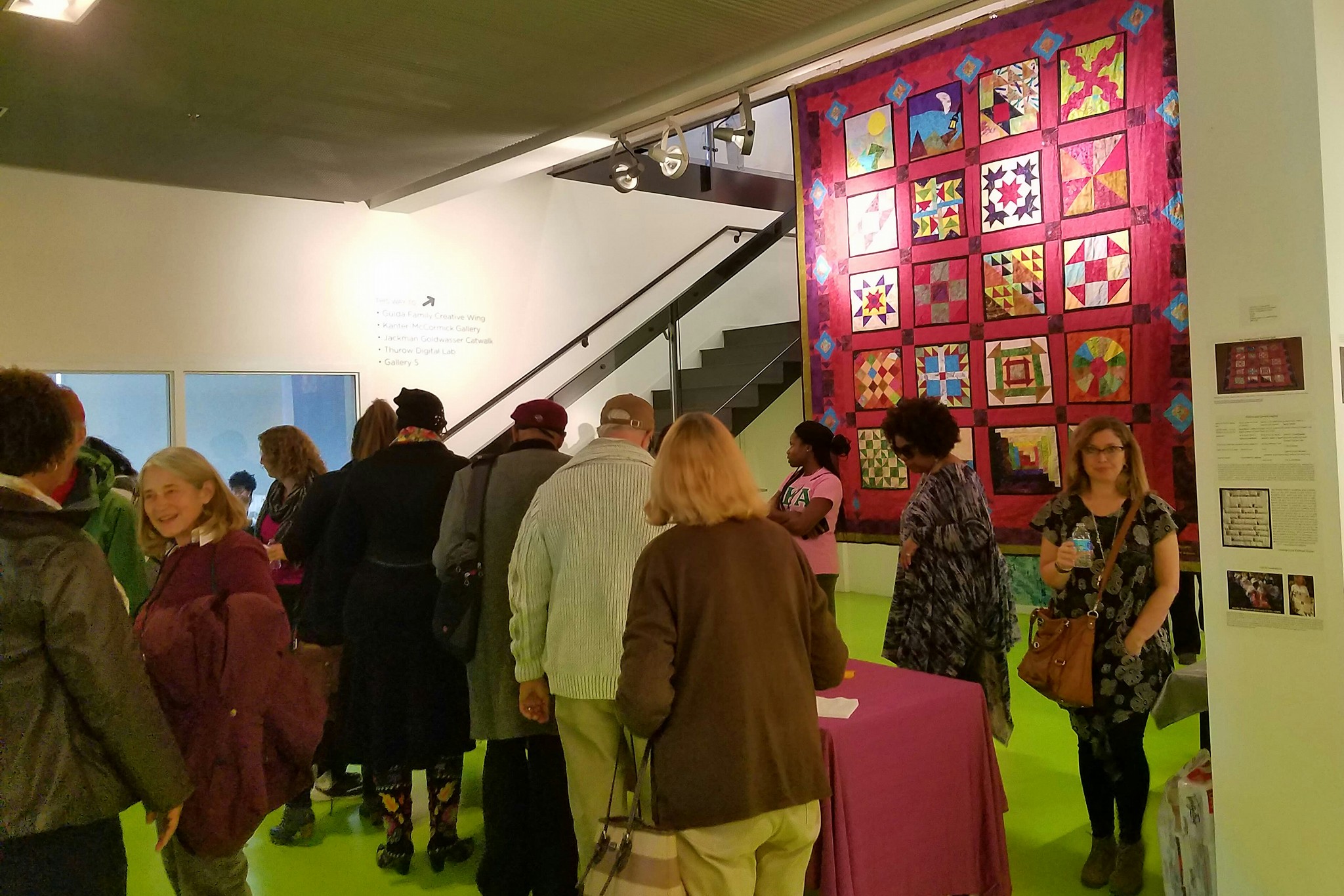
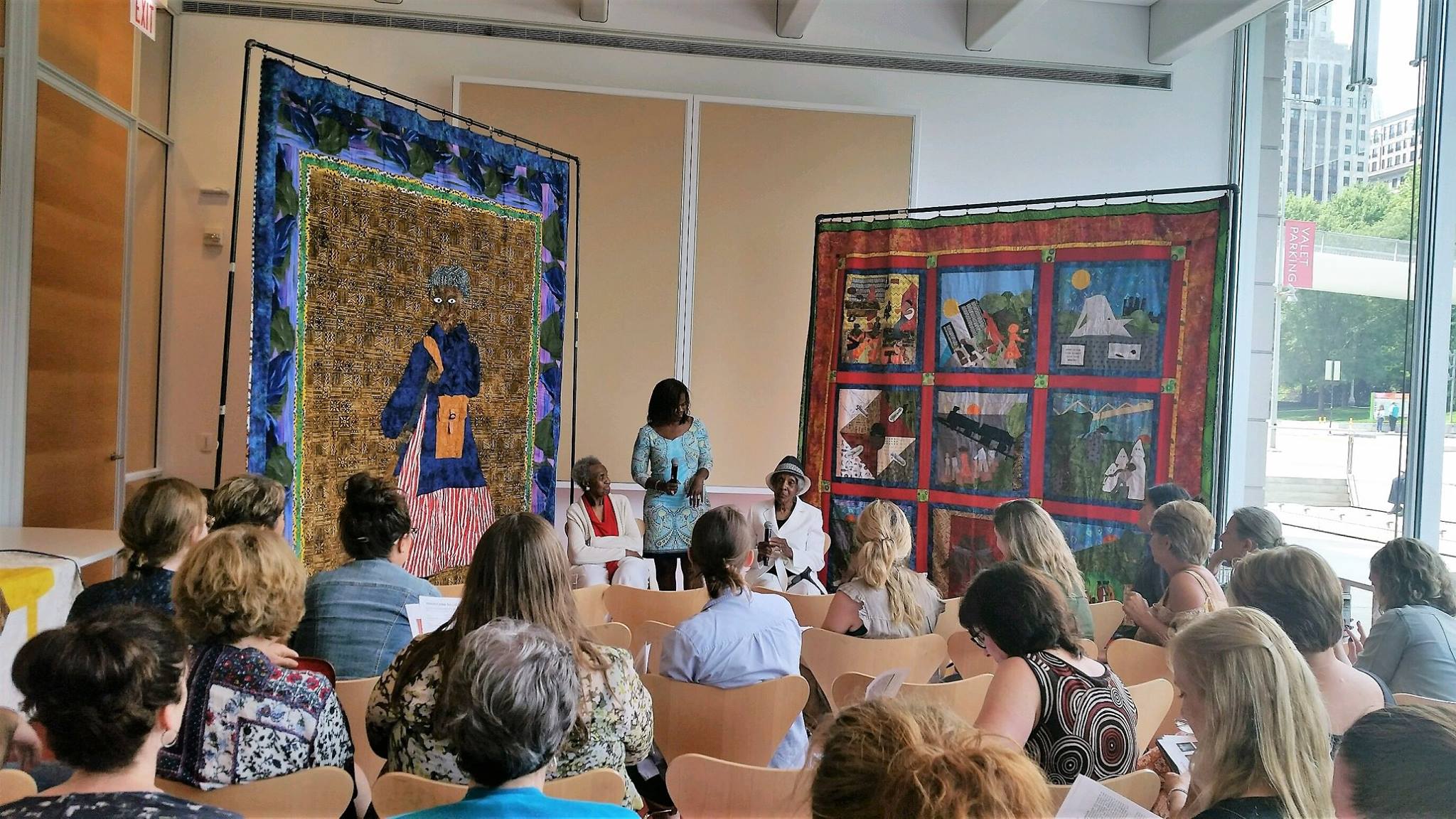
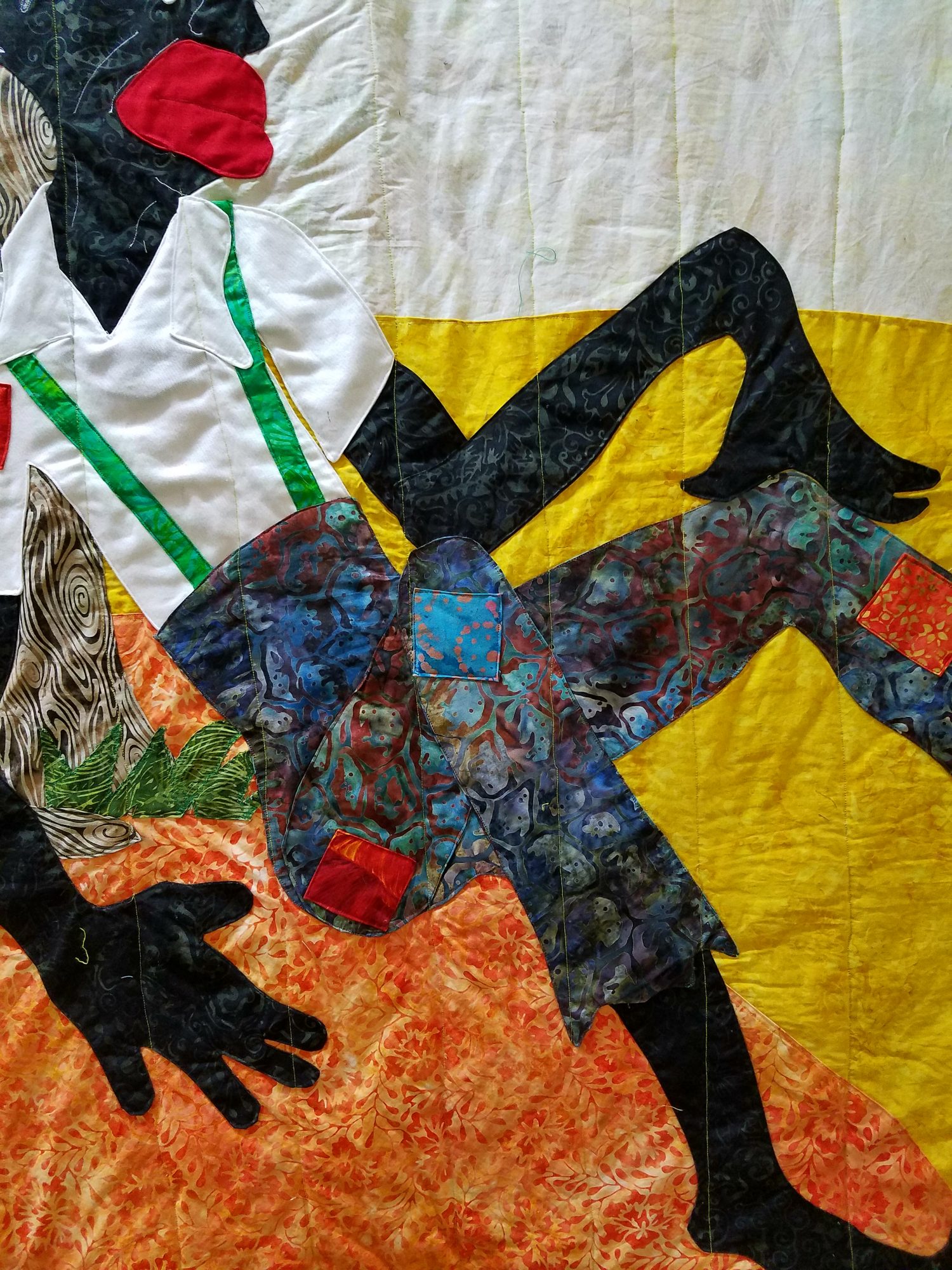
 Image Credit:
Audience at the Art Institute of Chicago (two quilts) Great Migration quilt John Straughter
Quilt Slave mourning the death of his master. Dorothy Straughter
Hyde Park Art Center Underground Railroad Quilt Dorothy C. Straughter
Getting in touch: VoyageChicago is built on recommendations from the community; it’s how we uncover hidden gems, so if you know someone who deserves recognition please let us know here.


